
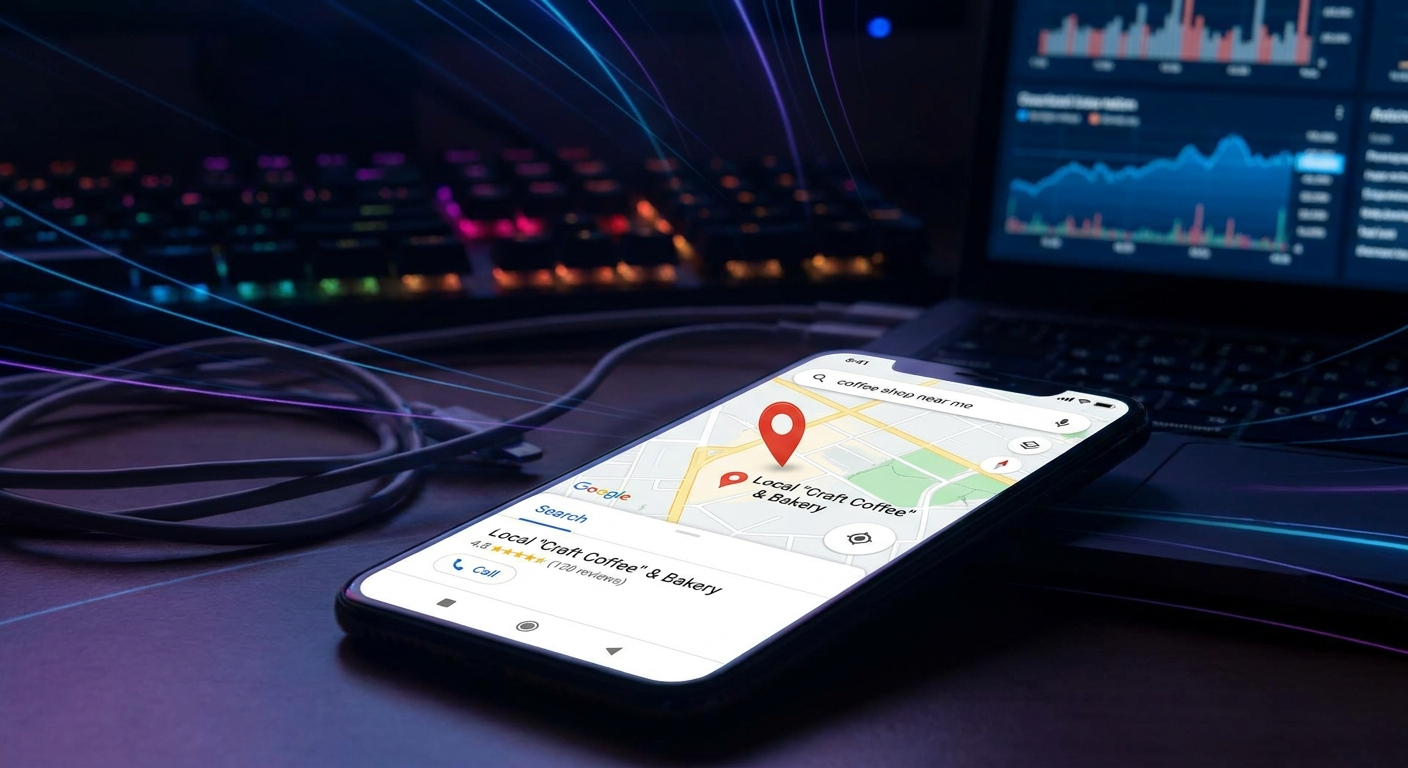
If you run a local service business and you're not actively thinking about local SEO, you're handing customers to competitors who are. Local SEO is the most cost-effective marketing channel available to small businesses — and most owners either ignore it completely or don't understand it well enough to act.
This guide changes that.
What Is Local SEO?
SEO stands for Search Engine Optimization — the practice of making your business show up higher in search results. Local SEO is specifically about showing up when people in your area search for what you offer.
When someone Googles "plumber near me" or "HVAC repair Los Angeles" or "best hair salon in Long Beach," local SEO determines whether your business shows up — and how high.
There are two main places you can show up in local search:
- The Map Pack — the three business listings that appear above organic results with a map, stars, and photos. This is prime real estate.
- Organic search results — the regular blue links below the map pack, which rank your website pages.
Both matter. The Map Pack is more important for most local service businesses because it appears higher and captures more clicks.
The Three Pillars of Local SEO
1. Your Google Business Profile
Your Google Business Profile (GBP) is the single most important factor in local SEO for most small businesses. It's the listing that appears in the Map Pack. If you haven't claimed yours, stop reading and do that first at business.google.com.
Once claimed, optimize every field:
- Business name: Use your actual business name — don't stuff keywords in it
- Category: Choose the most specific primary category available, then add secondary categories
- Service area: List every city and neighborhood you serve
- Hours: Keep these accurate and update them for holidays
- Photos: Add at least 10 real photos — exterior, interior, team, work samples. Profiles with more photos get significantly more clicks.
- Description: Write 750 characters describing what you do, where you serve, and what makes you different. Include your city and key services naturally.
- Services: List every service you offer with brief descriptions
- Posts: Google Business Posts (like mini social media updates) show on your profile and signal that you're active
2. Reviews
Reviews are the biggest differentiator in the Map Pack. Google uses quantity, recency, rating, and content of reviews as ranking signals. More recent reviews from real customers signal to Google that you're an active, trusted business.
The average small business has 11 reviews. Businesses that rank in the top three in their category typically have 50–200+.
How to get more reviews:
- Ask every satisfied customer — directly, personally, and right after the job is done
- Send a follow-up text or email with a direct link to your Google review page
- Use an automated review request system (we set these up for clients — it works)
- Never offer incentives for reviews (against Google's terms)
- Respond to every review — positive and negative. It shows you care and signals active management.
3. Your Website
Your website supports local SEO in two ways: it's the destination for organic search results, and Google uses it as a trust signal for your GBP.
For local SEO, your website needs:
- Location-specific pages if you serve multiple areas ("HVAC Repair Long Beach CA" as a page, for example)
- NAP consistency: Your Name, Address, and Phone number should appear exactly the same on your website, GBP, and every other listing online
- Local schema markup: Structured data that tells Google you're a local business (we add this to every site we build)
- City and service keywords in page titles and headings: Not stuffed — naturally included where relevant
Citations: The Supporting Structure
Citations are mentions of your business name, address, and phone number on other websites — Yelp, Yellow Pages, Angi, HomeAdvisor, and dozens of other directories. Google uses citation consistency as a trust signal.
The key is consistency. If your address appears differently across different directories (abbreviations, suite numbers, etc.), that inconsistency hurts your rankings. A citation cleanup and building campaign ensures your information is accurate everywhere that matters.
How Long Does Local SEO Take?
Honest answer: you'll see some movement within 30–60 days if you start from scratch on GBP optimization and review building. Meaningful improvements in competitive markets take 3–6 months of consistent work.
The reason to start now, even though it takes time, is that every month you wait is a month your competitors are pulling ahead. The gap only gets harder to close.
What You Can Do Today
- Claim and complete your Google Business Profile (30 minutes)
- Add at least 10 photos to your GBP (1 hour)
- Text your last five customers asking for a review with a direct link (15 minutes)
- Make sure your phone number is consistent and clickable on your website (15 minutes)
Those four actions, done today, will put you ahead of most small businesses in your area. Not because they're complicated — but because most businesses don't do them.
Want us to handle your local SEO?
Our Professional package includes comprehensive monthly SEO management, 100+ citation building, and ongoing GBP optimization. Book a free consultation to learn more.
Book Free Consultation